
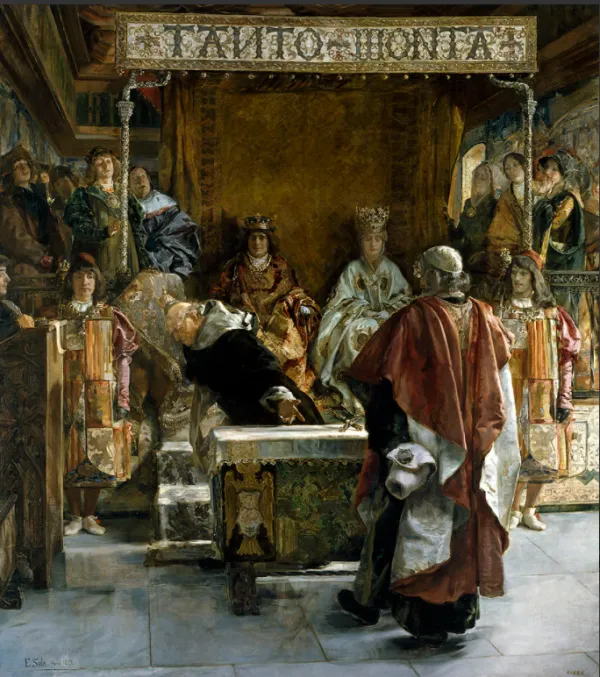
Expulsion of the jews out of spain: Nobelse, CC BY-SA 4.0 <https://creativecommons.org/licenses/by-sa/4.0>, via Wikimedia Commons
The voyage of Christopher Columbus in 1492 is often remembered as a triumphant undertaking financed by the Spanish crown, neatly encapsulated in the enduring myth of Queen Isabella I pawning her jewels. That image, repeated for centuries, is less history than propaganda—an oversimplified story that obscures the far more complex network of people and resources that made the expedition possible. A closer examination reveals that Jews and individuals of Jewish descent—particularly Conversos, or “New Christians”—were central to the enterprise. Their involvement spanned finance, political advocacy, and the scientific knowledge that made transatlantic navigation feasible in the first place.
Financially, the expedition depended heavily on Converso officials embedded within the Spanish state. Figures like Luis de Santángel, the chancellor of the royal household, and Gabriel Sánchez, the chief treasurer of Aragon, were instrumental in securing and advancing the funds Columbus needed. This was not incidental support—it was decisive. Without their intervention, the voyage may never have left port. At the same time, influential Jewish statesmen such as Isaac Abravanel operated within the political sphere, helping to cultivate an environment in which royal backing became possible.
Equally critical was the intellectual and scientific foundation provided by Jewish scholars. The astronomical tables associated with Abraham ibn Ezra and similar traditions allowed sailors to calculate latitude with greater precision, while instruments such as the quadrant gave navigators the practical means to apply that knowledge at sea.
What followed Columbus’s arrival in the Americas was not a benign “discovery,” but the beginning of conquest. The landing in 1492 marked the beginning of sustained European colonization, the systematic dispossession of Indigenous lands, and the collapse of entire civilizations. Violence, forced labor, disease, and cultural eradication would define the centuries that followed.
Fast forward to the 21st century, and the pattern is not just similar—it is uncomfortably recognizable. Political power and financial influence still operate behind carefully constructed public narratives, while citizens are presented with simplified language about “democracy,” “security,” and “shared values.” The difference is not the existence of influence, but how effectively it is managed, institutionalized, and normalized.
At the center of this entire structure is capitalism itself—the driving engine that makes expansion not just possible, but necessary. From the extraction of land and resources in the Americas after 1492 to the modern integration of military aid, defense industries, and technological systems, the logic remains consistent: accumulation requires access, control, and, when resisted, force. War, occupation, and geopolitical alignment are not deviations from this system; they are mechanisms through which it sustains and reproduces itself. What appears as policy is often the outward expression of deeper economic imperatives that demand continuous expansion, consolidation, and dominance.
In the United States, powerful lobbying organizations, defense industry advocacy groups, and ideological coalitions—including pro-Israel organizations and Christian Zionist movements—have, over decades, played a visible and decisive role in shaping American foreign policy toward Israel. This influence is not incidental or peripheral; it is embedded within the structure of policymaking itself. Within this framework, Israel has become deeply integrated into a broader U.S.-dominated geopolitical architecture, serving both as a strategic partner in maintaining American hegemony in the Middle East and as an actor advancing its own strategic objectives.
As a result, American presidents—from Barack Obama to Donald Trump to Joe Biden—have consistently taken strong pro-Israel positions. This support extends far beyond rhetoric; it is expressed through sustained political backing, financial commitments, and military assistance. In 2016, Obama signed a 10-year Memorandum of Understanding committing $38 billion in military aid to Israel—the largest bilateral military aid package in U.S. history.
Financial and political support for Israel has also been reinforced through campaign funding networks. During his 2008 presidential campaign—and earlier during his tenure in the U.S. Senate—Obama received substantial backing from donors aligned with pro-Israel lobbying groups, including the Pritzker family and Lee Rosenberg, who was closely connected to the American Israel Public Affairs Committee and served on Obama’s finance committee. These patterns illustrate how political alignment is not only expressed through policy, but also supported and reinforced through established funding networks.
Under the Biden administration, this pattern has not only continued but intensified. The United States provided at least $17.9 billion in military aid to Israel in the first year following the October 7, 2023 attacks, with broader estimates exceeding $21.7 billion when including extended appropriations into 2025. This support has included advanced weaponry, from precision-guided munitions to large-scale ordnance. Biden himself has openly identified as a “Zionist,” underscoring the ideological dimension that often accompanies these policy decisions, alongside the material commitments.
Support has also been heavily reinforced through campaign financing across the political spectrum. Biden has, over the course of his career, received with some estimates at over $11 million—making him number one recipient of pro-Israel lobbying groups. Similarly, pro-Israel funding played a major role in supporting Trump, with figures like Miriam Adelson channeling over $215 million into political action committees such as Preserve America PAC to back his campaigns. These financial flows are not marginal—they are central to how political influence is organized and exercised.
This dynamic extends well beyond the presidency. Politicians across party lines—including Jacky Rosen, Mitch McConnell, Lindsey Graham, as well as Hakeem Jeffries, Josh Gottheimer, Chuck Schumer, and Ritchie Torres—have all taken strong, consistent public positions in support of Israel, reinforced by substantial campaign contributions from pro-Israel lobbying groups.
Campaign financing, lobbying, and strategic alliances may be standard features of American politics, but that does not render their impact neutral. They shape policy priorities, define the boundaries of acceptable debate, and determine which perspectives are elevated—and which are systematically pushed to the margins. In case of Isreal, this level of sustained and coordinated financial support is not incidental—it reflects a durable alignment of political interests and helps explain the continuity of policy positions, regardless of shifting political contexts.
A similar dynamic is visible in the technological sphere. Figures like Alex Karp, Palmer Luckey, and Dario Amodei represent a new kind of power broker—one rooted not in court politics or traditional finance, but in control over data, algorithms, infrastructure and ideological alignment. Their companies—Palantir Technologies, Anduril Industries, and Anthropic—are deeply integrated into U.S. defense and intelligence systems, contributing tools for enhanced surveillance, analysis, and operational decision-making, described as a new kill chain.
However, framing them as modern equivalents of Abraham ibn Ezra risks misunderstanding the scale and nature of their role. Ibn Ezra contributed to the accumulation of knowledge; these firms are embedding that knowledge directly into systems that can influence real-time military outcomes. Platforms like Palantir’s data analytics tools do not just inform decisions—they structure them, shaping how information is prioritized, interpreted, and acted upon. This is not a neutral evolution of science; it is the integration of technological capability into the execution of power.
What should draw scrutiny is not simply that these actors exist but how normalized their influence has become. Advanced military technologies are framed as innovation. Political alignment is framed as consensus. Structural influence is framed as coincidence. Each layer of framing distances the public from the underlying reality: that power is being exercised through interconnected networks of finance, politics, and technology that are rarely examined as a whole.
What followed the Balfour Declaration in November 1917 was not simply a diplomatic milestone, but the beginning of a prolonged and deeply contested political transformation in Palestine. Issued by the British government during wartime, the declaration expressed support for the establishment of a “national home for the Jewish people” in a land already inhabited by an Arab majority. In the decades that followed—through the period of the British Mandate and especially after the creation of the State of Israel in 1948—this commitment became entangled with displacement and recurring violence against Palestinians. The West Bank and Gaza Strip remain central to this conflict, with conditions widely described as an apartheid system. The situation is not identical to European colonial patterns—particularly in the Americas—but the parallel often drawn is the persistence of expansion, settlement, and the erosion of indigenous social and political structures under colonial power.
In the present day, the dynamics of control and war are being reshaped by advances in artificial intelligence. The reported use of AI-assisted targeting systems such as “Lavender” and “The Gospel” marks a decisive shift in how military force is organized and executed—one deeply embedded within defense technology ecosystems tied to the United States and Israel. What is taking shape is not merely a technological upgrade, but a structural escalation: the delegation of life-and-death decisions to systems designed to process, sort, and act at a scale no human institution could sustain on its own.
This transformation is already visible in the ongoing war with Iran. Since the launch of joint U.S.–Israeli operations in February 2026, thousands of targets inside Iran—including military infrastructure and civilian areas such as schools, universities, and hospitals—have been struck. Senior military and political figures have also been targeted and killed through tightly integrated campaigns combining surveillance, data analysis, and precision weaponry. These are not isolated acts of force—they are outputs of a system. Targeting is no longer a discrete human decision; it is a continuous process, accelerated by algorithms that determine what is seen, what is prioritized, and ultimately, what is destroyed.
The parallel to 1492 is not technological, but structural. Just as the voyage of Christopher Columbus was enabled by a convergence of financing, political backing, and navigational knowledge that made conquest possible at scale, today’s wars are enabled by an alignment of capital, state power, and computational systems that make continuous, high-speed violence sustainable. Then, the tools were ships and charts; now, they are data pipelines and machine learning models. But in both cases, the effect is the same: expansion becomes operationally feasible, and once feasible, it becomes normalized.
What distinguishes the present is not restraint, but efficiency. Violence no longer requires the same visible mobilization—it is embedded into systems that run continuously, quietly, and with increasing autonomy. Responsibility becomes harder to locate, not because it disappears, but because it is distributed across networks of engineers, policymakers, military planners, and private firms. The result is a form of power that is both more diffuse and more absolute: harder to challenge, faster to act, and far less accountable.
This is not an evolution away from the past—it is its refinement.
Conclusion
The link between the financing of Christopher Columbus’s expedition and the United States’ support for Israel’s occupation of the Gaza Strip and West Bank is not a coincidence. It is a recurring architecture of power. Expansion and domination are never organic—they are constructed, funded, and politically engineered through networks that make them appear necessary, justified, and inevitable. Within this framework, resistance to occupation is not simply opposed—it is routinely reframed, labeled as terrorism, and delegitimized to preserve the structure itself.
Columbus did not sail on a whim; he sailed with capital, political backing, and the technical knowledge to convert ambition into conquest. Strip away the myth, and what remains is coordination and intent. Today, the American-led world order functions the same way: Gaza, the West Bank, and the broader regional conflicts—from Syria to Lebanon to Iran—persist not because of abstract necessity, but because military aid, diplomatic protection, technological integration, and political alignment converge to sustain them.
These systems do not merely coexist—they reinforce one another. Military funding underwrites diplomatic positions. Political incentives enforce silence. Technology accelerates and operationalizes force. Together, they compress the space of possibility until occupation and violence appear inevitable—not because they are broadly supported, but because opposition has been systematically constrained.
The public is presented with a simplified narrative: national security, the fight against terrorism, regional stability, the promotion of democracy. Behind it lies a diffuse system that obscures responsibility, fragments power, and renders meaningful resistance ineffective. Then, as now, the consequences are borne by those with the least power to resist—Indigenous peoples in the Americas and Palestinians and broader Middle East today.
Since Donald Trump’s presidency, U.S. foreign policy in the Middle East operates almost in lockstep with Israeli strategic objectives, often with minimal independent assessment. The lesson is brutal and unmistakable: from 1492 to today, expansion and violence are never accidental—they are engineered. Columbus’s ships destroyed worlds with planning, funding, and intent; modern U.S. support for Israel weaponized money, diplomacy, and technology to achieve the same result. In both cases, power operates through networks that hide accountability, normalize destruction, and leave the most vulnerable to bear the cost. These are not tragic accidents—they are deliberate, sustained, and defended choices, repeated across centuries with chilling consistency.